
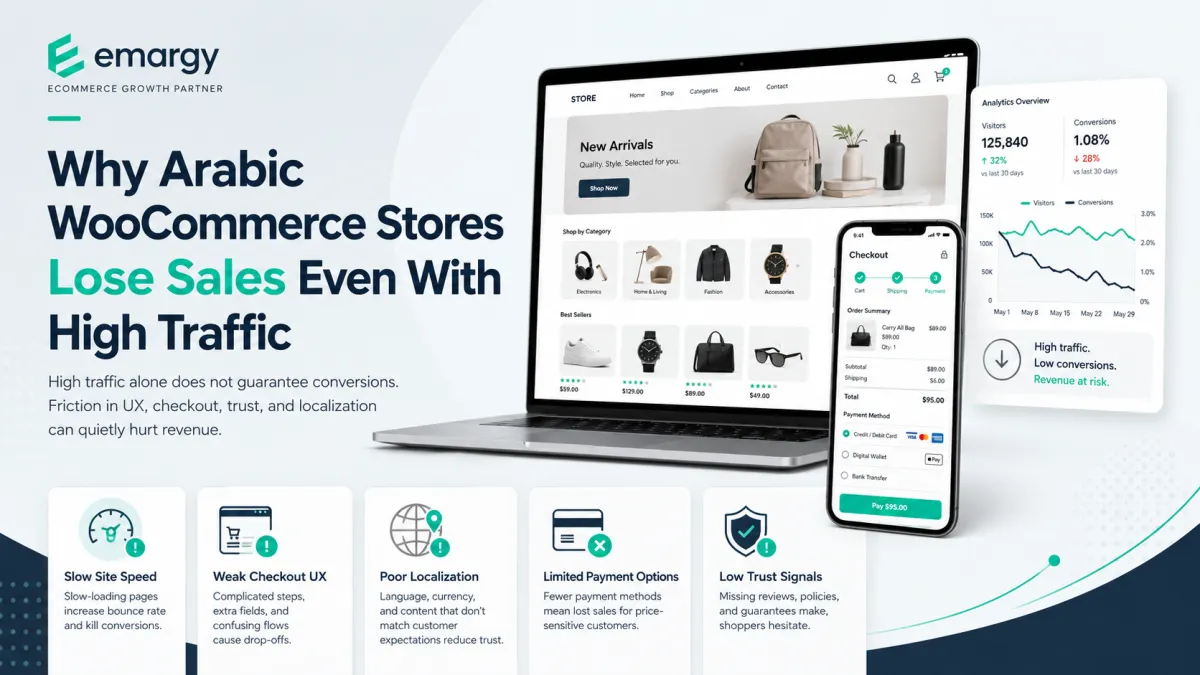
Why can a localized store still convert poorly?
Arabic translation alone does not make a checkout local. A buyer can read every label and still encounter an address form that does not match local delivery, a payment method unavailable in their country, an LTR error message inside an RTL page, or a currency total that changes at payment.
The GCC is not one checkout market. Saudi Arabia, the UAE, Kuwait, Qatar, Bahrain, and Oman differ in payment availability, address conventions, tax presentation, delivery operations, and customer expectations. Build a country test matrix instead of a single “Arabic version.”
1. Review the Arabic as interface copy
Translate actions and error states in context, not as isolated words. Check cart, coupon, stock, shipping, payment failure, order confirmation, email, and account messages. Product names and brand terms may remain in English when that is how customers recognize them. Use a native reviewer who understands commerce, not only grammar.
2. Test bidirectional content
An RTL page still contains LTR data: email addresses, coupon codes, SKUs, card numbers, phone numbers, and Latin product names. Verify alignment, cursor behavior, wrapping, icons, validation, and copied text. Test long Arabic names and mixed Arabic/English addresses rather than a short placeholder.
3. Match the address to fulfilment
Ask the carrier and operations team which fields are actually required in each destination. City, district, street, building, unit, landmark, national-address data, and postal code should be configured from fulfilment needs—not from assumptions about “the region.” Validate phone country codes and preserve the international number used by delivery teams.
4. Verify payment methods inside the real checkout
Availability can depend on merchant country, buyer country, currency, device, browser, gateway account, and transaction type. Test the exact production configuration. Record which method appears and succeeds for each country/device combination; do not advertise a wallet merely because the gateway supports it in another market.
5. Make delivery and returns legible
Before payment, show delivery range, fees, free-shipping threshold, dispatch cutoff, and return conditions in the customer’s language. For cash on delivery, measure refusal and return-to-origin costs separately. Do not add a fee or force confirmation without checking local law and gateway/carrier terms.
6. Keep currency consistent
Use one clear order currency through product, cart, checkout, payment, confirmation, and refund. If you display an estimate in another currency, label it as an estimate and state which currency will be charged. Test decimals, Arabic/Latin numerals, and tax-inclusive or tax-exclusive labels.
GCC checkout test matrix
| Area | Test | Evidence |
|---|---|---|
| Language | Success and failure paths | Screen recording |
| Address | Real carrier requirements | Test shipment |
| Payment | Country × device × method | Gateway result |
| Delivery | Fee and promise accuracy | Order timeline |
| Support | Arabic question before purchase | Response time |
Run the matrix before buying more traffic. If customers can complete payment but leave earlier, use our checkout-friction audit. If messaging is part of support or recovery, read the WhatsApp guide before automating contact.